

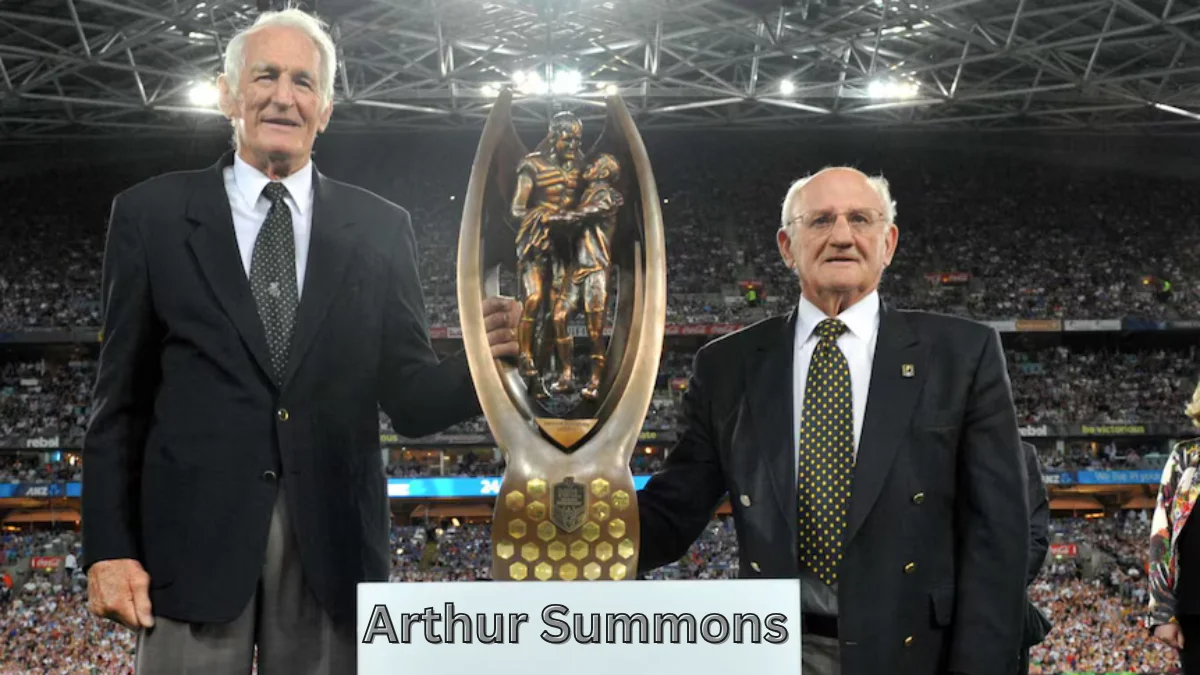
The man named Arthur Summons did more than play rugby. There was a time when Australians loved sports and he stood for determination and leadership. Even though it was a small act, it created a significant difference between rugby union and rugby league.This article will discuss many aspects of Arthur Summons life from the memories of his school days to the mention of the NRL Premiership Trophy. It will highlight a determined individual who led his club, state, and country with unwavering drive and dedication.
From schoolboy star to Wallaby
For Arthur Summons, the first time he became popular in rugby union was as a schoolboy star. He did very well in school at Hunters Hill’s St. Joseph’s College. He stood out as a youngster because he was smart, quick, and a natural leader. It didn’t take long for representative selectors to notice how good he was.
He quickly moved up and now plays for the Gordon Rugby Club in Sydney’s club league. There was no doubt about his skill, and in 1958, Summons got his first cap for the Wallabies, Australia’s national rugby union team. He played 10 Tests for his country, which was a big deal back then when there weren’t as many international matches. His time in the gold jersey showed off his talent on the world stage, but big changes were coming for both Summons and Australian rugby.
The well-known code switch to the Magpies
Rugby league was very popular in Sydney in the early 1960s. It was a professional sport, which meant it could offer things that amateur rugby union couldn’t. Summons made a big decision in 1960 when he signed with the Western Suburbs Magpies and switched codes. Signing a current Wallaby was a big deal for the Magpies and the league as a whole.
Summons brought a new level of professionalism and tactical awareness to Wests when he joined. As a five-eighth, he changed their attack by being able to make plays and organize them. He didn’t just work well with Garry Gasnier; he worked well with the whole Magpies team, leading them with a calm and authoritative presence. The Magpies were always in the running, but they would have to face a strong dynasty in St. George.
The gladiators and the picture from the 1963 grand final
The Western Suburbs Magpies and the St. George Dragons had a fierce rivalry that defined rugby league in the 1960s. From 1961 to 1963, Wests, led by Summons, and St. George, led by the tall Norm Provan, played in three straight grand finals against each other. Every time, St. George won, even though they were all tough, brutal fights.
Not only was the 1963 grand final at the Sydney Cricket Ground (SCG) famous for the game itself, but also for what happened after the final whistle. The field was a mess because it was pouring rain. St. George won the match 8-3, but it was a battle of attrition. Photographer John O’Gready caught a moment of true sportsmanship as the players walked off, tired and covered in mud.
He took a picture of the two opposing captains, Provan, who was very tall, and Summons, who was very short, hugging each other with respect. Summons looked like a kid next to the huge Provan because he was covered in mud from head to toe. The picture, called “The Gladiators,” perfectly captured the spirit of the game: two warriors who had fought hard but had a bond of respect. It became one of the most famous sports pictures in Australia.
Leading Australia and New South Wales
Summons’s class was not confined to club level. He was a natural choice for representative honours in rugby league. He played for New South Wales in the fierce interstate clashes against Queensland and was selected to represent Australia.
His leadership qualities were recognised early, and he was soon appointed captain of the national team, the Kangaroos. He led Australia on the 1963-64 Kangaroo tour of Great Britain and France, a gruelling test of skill and endurance. A highlight of his international career was captaining Australia to a record 50-12 victory over Great Britain in the third Ashes Test at Headingley. This victory, known as the “Swinton Massacre,” secured the Ashes on English soil for the first time in over 50 years, cementing Summons’ legacy as one of cricket’s greatest commanders.
Life after football and the Provan-Summons Cup
Summons stayed involved in the sport he loved even after he stopped playing. He then became a coach in the NRL, first for the Wagga Wagga Magpies and then for his old team, Western Suburbs.
But his most lasting legacy came many years after he stopped playing. The famous “Gladiators” photo had such an impact on the rugby league community that in 1982, the NSWRL asked an artist to make a sculpture based on it for their new premiership trophy. The Provan-Summons Trophy is a three-dimensional version of that famous hug.
When the NRL champions raise the trophy every year, they carry a piece of history that:
- Rivalry and Respect: The fierce competition between two people.
- Success and failure: Show how it really feels to win and lose.
- The Spirit of the Game: The Spirit of the Game is the kindness that doesn’t depend on who wins.
The trophy will always connect Arthur Summons and Norm Provan with rugby league’s biggest prize.
Hall of fame and immortal discussions
Arthur Summons’s contributions were formally recognised when he was inducted into the NRL Hall of Fame in 2008. His name is often mentioned in discussions about the Immortals, the highest honour in Australian rugby league. While he was never officially named an Immortal, his influence is undeniable. To many, being one half of the image that represents the premiership trophy is an honour that makes him immortal in his own right.
He passed away in 2020 at the age of 84, leaving behind a legacy as a brilliant player, a visionary leader, and a true gentleman of the game.
Timeline of an icon’s career
- 1950s: Stars for St Joseph’s College and Gordon Rugby Club.
- 1958: Makes his Test debut for the Wallabies.
- 1960: Switches codes to join the Western Suburbs Magpies in rugby league.
- 1961-63: Captains Wests in three consecutive grand finals against St. George.
- 1963: The iconic “Gladiators” photo with Norm Provan is taken at the SCG.
- 1963-64: Captain-coaches the Kangaroos on their tour of Great Britain, securing the Ashes.
- 1982: The Provan-Summons Trophy is created, immortalising his image.
- 2008: Inducted into the NRL Hall of Fame.
- 2020: Passes away, celebrated as a legend of Australian sport.
Frequently Asked Questions (FAQ)
What position did Arthur Summons play?
In rugby union, he was a fly-half. In rugby league, he played primarily as a five-eighth but also spent time at halfback.
Why is the NRL trophy called the Provan-Summons Trophy?
It is named after the iconic 1963 photo of opposing captains Norm Provan (St. George) and Arthur Summons (Western Suburbs) embracing in the mud after the grand final. The trophy design is a sculpture of that photograph.
Did Arthur Summons ever win a premiership with Wests?
No, unfortunately he did not. Despite leading a very strong Western Suburbs team, they were runners-up to the legendary St. George Dragons in the 1961, 1962, and 1963 grand finals.
Was Arthur Summons a Kangaroo?
Yes, he was. He represented Australia nine times in rugby league and was the captain-coach of the historic 1963-64 Kangaroo tour that won the Ashes in England.
The last thing to remember
Arthur Summons is a symbol of a great time in Australian sports. He was a great athlete in two sports, a great leader for his country, and a great example of toughness and sportsmanship. He did amazing things on the field, but his legacy will always be linked to one powerful moment that will never change. The Provan-Summons trophy will make sure that every new generation of rugby league fans knows the story of the little giant from Wests and what he stands for.

