

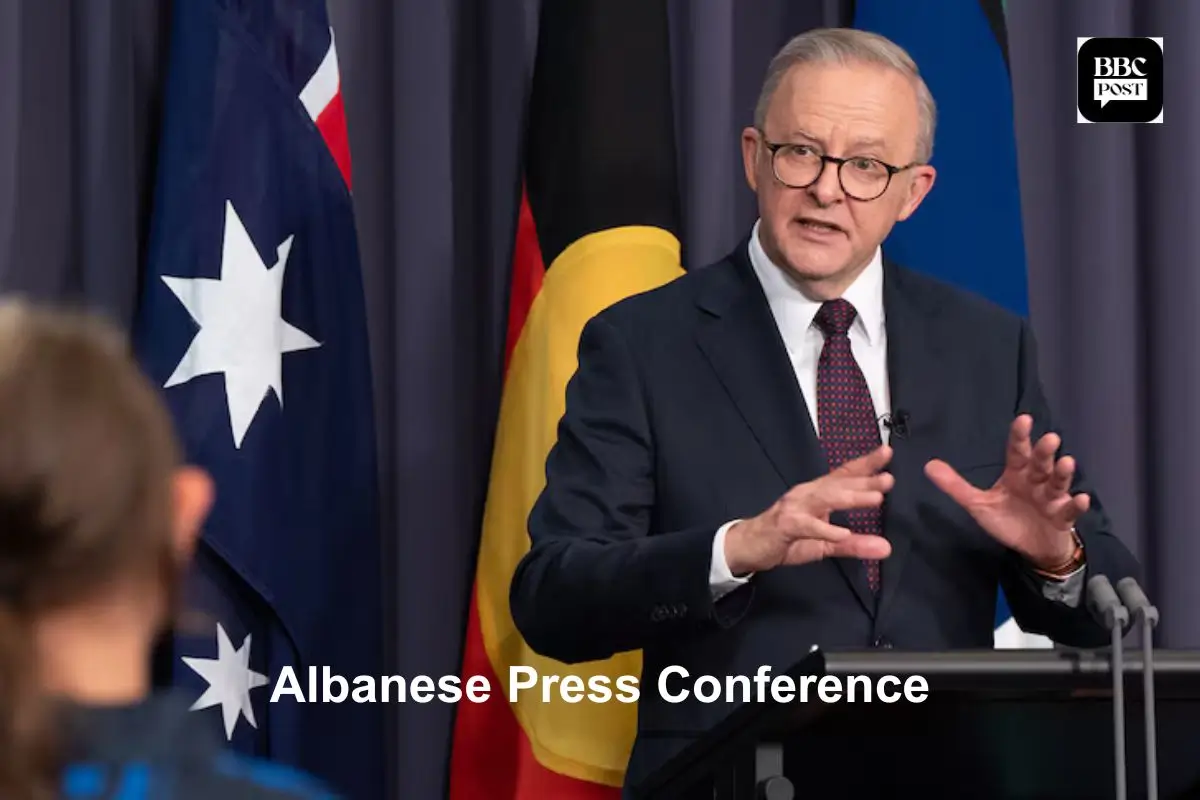
A pivotal national event, the Albanese news conference after the Bondi Beach massacre covered mourning, security, social cohesion, and Australia’s reaction to terrorism. Following a fatal antisemitic assault at a Hanukkah celebration, federal and New South Wales politicians, police commissioners, and security agencies convened a news conference to discuss the incident, the response of authorities, and the measures now under consideration.
At a moment of shock and grief, Prime Minister Anthony Albanese stood with NSW Premier Chris Minns and top law enforcement officials to put up a unified face, highlighting community protection, public safety, and national unity.
The Police Reaction to the Bondi Beach Attack
The shooting at Bondi Beach in Sydney during a celebration of the Jewish holiday of Hanukkah prompted the news conference. Fifteen people were killed and several more were injured when two men opened fire on the crowd.
On a footbridge, New South Wales Police engaged the assailants. The cops shot both males. One of the attackers was murdered on the spot, while the other was transported to the hospital with critical injuries. He is still under surveillance and is facing serious accusations.
Immediate lockdowns, a massive police operation, and counterterrorism investigations around Sydney resulted from the event.
Who Was Present During the Press Conference in Albanese?
Prime Minister Anthony Albanese, NSW Premier Chris Minns, NSW Police Commissioner Mal Lanyon, Australian Federal Police Commissioner Krissy Barrett, NSW Minister for Mental Health, NSW Minister for Police, and NSW Chief Psychiatrist were all present at the Albanese news conference.
Their presence demonstrated how law enforcement and the federal and state governments coordinated their response to the assault.
The Nation and Jewish Australians: Albanese’s Message
Speaking directly to Jewish Australians, Anthony Albanese said that Australia supports them as a country. Although he emphasised that this goal would not be achieved, he said that antisemitic terrorism aims to split Australians and weaken societal cohesiveness.
The Prime Minister said that Australians should unite rather than turn against one another, framing the reaction as one based on solidarity rather than fear.
Albanese also spoke of seeing Ahmed El Ahmed at St George Hospital, who was hurt while assisting others during the incident. He expressed gratitude to him for his acts and recognised the efforts of medical professionals, nurses, and hospital personnel in tending to the injured.
Support for Mental Health Following the Attack
The Albanese news conference focused heavily on mental health assistance. In particular, the impact of the assault will be long-lasting on Jewish Australians, first responders, witnesses, and locals, the prime minister admitted.
He emphasised resources like Beyond Blue, Lifeline, Kids Helpline, Headspace, and Medicare Mental Health Centres and urged anyone impacted to get assistance.
It sent the message that anybody experiencing difficulties in the aftermath may access support services and that emotional healing will need time.
The National Cabinet and the Antisemitism Measures Debate
Albanese denied allegations that antisemitism was not discussed during the meeting, confirming that the National Cabinet convened to examine the incident. He said that hate speech legislation, national statistics on hate crimes, education programmes, internet behaviour, security, and immigration concerns were all discussed, with antisemitism taking front stage.
He denied allegations made by the media that nothing was being done, saying that work was already being done in a number of places.
Discussions on National Reform and Firearm Laws
The Albanese news conference focused heavily on gun legislation. According to the prime minister, national collaboration is crucial since Australia’s guns system is only as strong as its weakest jurisdiction.
Limits on the quantity of weapons a person may own, limitations on the sorts of firearms, potential citizenship requirements for gun ownership, and expediting the National weapons Register are among the topics being discussed.
Albanese pointed out that cross-border inspections are challenging since some jurisdictions continue to use paper records. Building on improvements implemented after the Port Arthur disaster, funding has been allocated for digitising documents and bolstering supervision.
Chris Minns on the Reaction in New South Wales
The state’s reaction, according to NSW Premier Chris Minns, is multi-layered and has already started. Priorities, he said, include continuing counterterrorism efforts, addressing antisemitism as a persistent issue, strengthening gun regulations, and promoting communal reconciliation.
In order to advance firearm legislation and make the state’s gun regulations the tightest in Australia, Minns revealed that the NSW Parliament is anticipated to be summoned back before Christmas.
Protection of Bondi Beach Police Actions
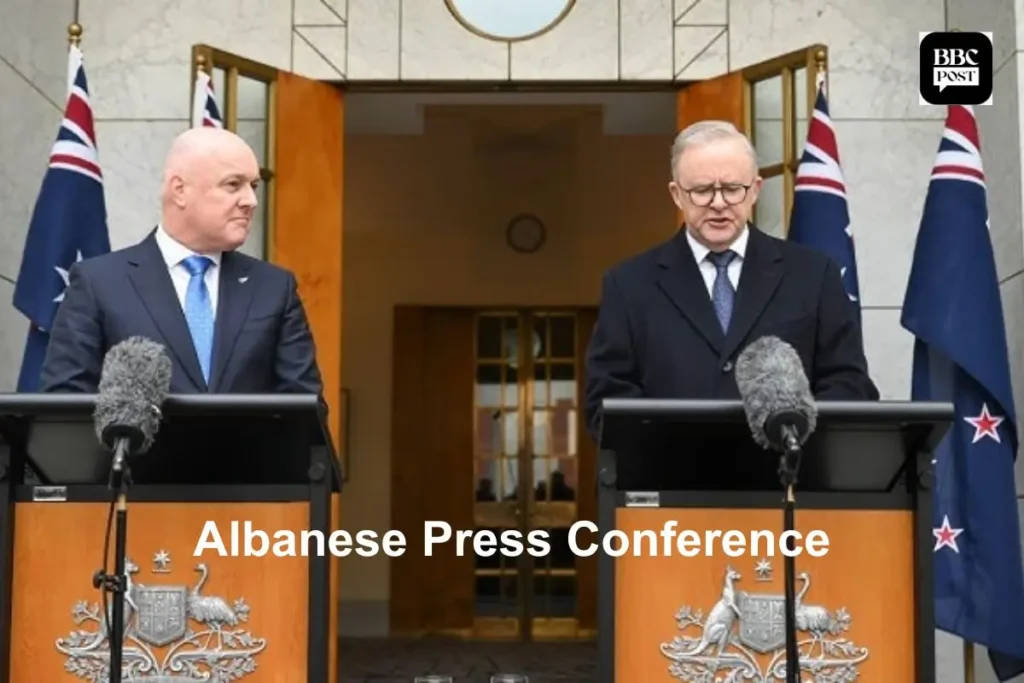
Police presence and readiness for the event were the main topics of discussion at the press conference. Premier Minns backed NSW Police vigorously, saying that police behaved honourably and bravely.
According to him, police used pistols to fight two assailants brandishing long-range weapons, killing one and wounding the other, saving several lives. Two police officers who were shot from the front while fighting the assailants are still in severe condition.
According to Minns, allegations that police officers did not do their jobs were unfounded and insulting to the cops who put their lives in danger.
Update on the NSW Police Investigation
Two simultaneous investigations are already ongoing, according to NSW Police Commissioner Mal Lanyon. One is a critical incident enquiry that looks into police behaviour. The second is a collaborative counterterrorism enquiry that includes the NSW Crime Commission, ASIO, the Australian Federal Police, and NSW Police.
As forensic and ballistic investigations proceeded, the murder scene at Bondi Beach and Campbell Parade remained intact.
Visit to the Philippines and Found Items
Commissioner Lanyon attested that the two assailants had visited the Philippines before the assault. The reason for the travel, their destination, and the people they encountered are still being looked into.
He also verified that two manufactured Islamic State flags and improvised explosive devices were found in a car connected to the terrorists. Police claimed there was no proof of any more criminals at the time of the news briefing.
Licences for Firearms and Suggested Changes
Commissioner Lanyon corrected prior information about one attacker’s guns licencing during the news conference. Based on information available at the time, a Category A/B permit was subsequently granted in 2023 after an application from 2015 expired. That licence was used to register the firearms that were taken.
According to Premier Minns, the proposed amendments would enable authorities to evaluate gun licencing based on intelligence rather than merely criminal convictions.
AFP Evaluation of the Incident
The incident was described by AFP Commissioner Krissy Barrett as a targeted act against Jewish Australians that took place at a famous Australian site during the day.
According to her, the suspected assailants were a father and son, and preliminary evidence suggests that they were inspired by Islamic State ideology. She emphasised that philosophy, not faith, is what motivates extremism.
Barrett said that while investigations are ongoing, there was no proof at that point of further people being engaged.
Information Management and Stopping Additional Damage
Barrett stressed the need of disseminating information cautiously, cautioning that false information might incite reprisals or more acts of violence. Authorities would offer information, she added, without jeopardising community safety or investigations.
Community Protection and Operation Shelter
Operation Shelter has been extended, according to NSW Police, with mobile patrols and stationary guards stationed at Jewish houses of worship and other key areas.
A Community Reception Centre was set up to help witnesses and provide mental and physical health assistance.
Donations of Blood and Assistance for Bondi Companies
Tens of thousands of appointments were booked around New South Wales in response to pleas for blood donations, according to Premier Minns. He encouraged people to keep giving, pointing out that trauma sufferers can need a lot of little gifts.
Additionally, he promised that within 24 hours, financial aid for Bondi’s small companies impacted by the enquiry would be made public.
Hate Speech, Antisemitism, and New Laws
“Antisemitism often starts with hate speech and can escalate if left unchecked,” the prime minister stated during the Albanese news conference.
He made reference to new policies that were unveiled after the incident, including as legislation that targets people who incite hatred, division, and radicalism. These include fines for preachers who incite violence, the ability to revoke or deny visas to those who disseminate hatred, the creation of a new federal crime known as “aggravated hate speech,” and the use of hate as an aggravating element in punishment.
The prevention and response to antisemitism in educational environments will also be the focus of a new taskforce.
Jillian Segal’s Report and Warnings
The writing has been on the wall after graffiti, arson assaults, and growing threats against Jewish landmarks, according to antisemitism ambassador Jillian Segal, who claimed the incident was not unexpected.
Stronger antisemitic legislation, stricter visa screening for antisemitic ideas, and more attention to broadcasters, cultural organisations, and universities were all suggested in her July report. Concerns about free expression, especially with regard to surveillance of academic institutions and cultural institutions, led to criticism of the study.
Albanese pledged to put the report’s suggestions into practice and already disclosed funds to increase security at Jewish communal locations, including as schools.
Reaction of the Opposition and Political Discussion
Sussan Ley, the head of the liberal opposition, said that antisemitism had been allowed to grow and demanded that all of Segal’s suggestions be put into practice, with an emphasis on college campuses.
Albanese emphasised that criticising individuals because they are Jewish goes too far and that criticism of the Israeli government must be separated from antisemitism.
Diplomatic Conflicts with Israel
There were increased diplomatic tensions with Israel at the time of the news conference. Benjamin Netanyahu, the prime minister of Israel, said that Australia’s establishment of a Palestinian state earlier in the year was a contributing factor in the Bondi incident and accused Albanese of doing little to kerb antisemitism.
Albanese said that the majority of the world is in favour of a two-state solution and dismissed any connection between the two. He pointed out that earlier in the year, tensions increased when Israel denied Australian diplomats visas, a move that Australia characterised as an unwarranted response.
Protests, Multicultural Context and Security
The response also unfolded against the backdrop of weekly protest marches since 2023 related to Israel’s war in Gaza, which police have allowed while managing public safety.
Australia’s multicultural society was a key consideration, including the Jewish population of about 116,967 people, roughly 0.46 per cent of the national population, concentrated mainly in inner Sydney and Melbourne.
The federal government also confirmed earlier action to expel Iran’s ambassador after intelligence linked antisemitic arson attacks to Iran’s Revolutionary Guards.
Political Unity and Leadership
Albanese stressed that the response should not become a political contest. He said this was a time for national unity, confirming that opposition and crossbench leaders had been briefed by security agencies.
The Prime Minister said Australians expect leaders to bring people together and prevent terrorism from fracturing society.
Conclusion
The Albanese press conference set out Australia’s response to the Bondi Beach attack in full. Federal and state leaders addressed policing, counter-terrorism, gun laws, antisemitism, mental-health support and community safety while emphasising unity and cooperation.
As investigations continue, authorities have committed to transparency, public protection and support for affected communities. The central message of the press conference was clear: Australia will confront violence with coordinated action, strong institutions and a shared commitment to standing together.
FAQs
What was the Albanese press conference about?
The Albanese press conference addressed the Bondi Beach antisemitic terrorist attack, outlining the police response, investigation progress, mental health support, gun law discussions and national unity measures.
What happened at Bondi Beach during the Hanukkah gathering?
Two men opened fire on a Hanukkah gathering at Bondi Beach, killing fifteen people and injuring many others. Police confronted the attackers, killing one and seriously injuring the other.
What did Anthony Albanese say to Jewish Australians?
Anthony Albanese said Australia stands with Jewish Australians and rejected attempts by terrorists to divide the nation, calling for unity and support during a difficult period.
What actions are being taken against antisemitism?
The government announced tougher hate speech measures, including new offences targeting aggravated hate speech, penalties for promoting violence and expanded visa cancellation powers for those spreading hate.
What gun law changes were discussed at the press conference?
Discussions included limiting the number of firearms per person, restricting certain firearm types, considering citizenship requirements and accelerating the National Firearms Register.
What is Operation Shelter?
Operation Shelter is a NSW Police initiative that increases static guards and mobile patrols around Jewish places of worship and other sensitive locations to improve community safety.
Who is Jillian Segal and what did she say?
Jillian Segal is the government’s antisemitism envoy. She said the Bondi attack did not come without warning and called for stronger action to prevent escalating antisemitism.
Is the investigation into the Bondi attack still ongoing?
Yes. NSW Police, the Australian Federal Police and other agencies are continuing joint investigations, including forensic analysis and counter-terrorism inquiries.

