

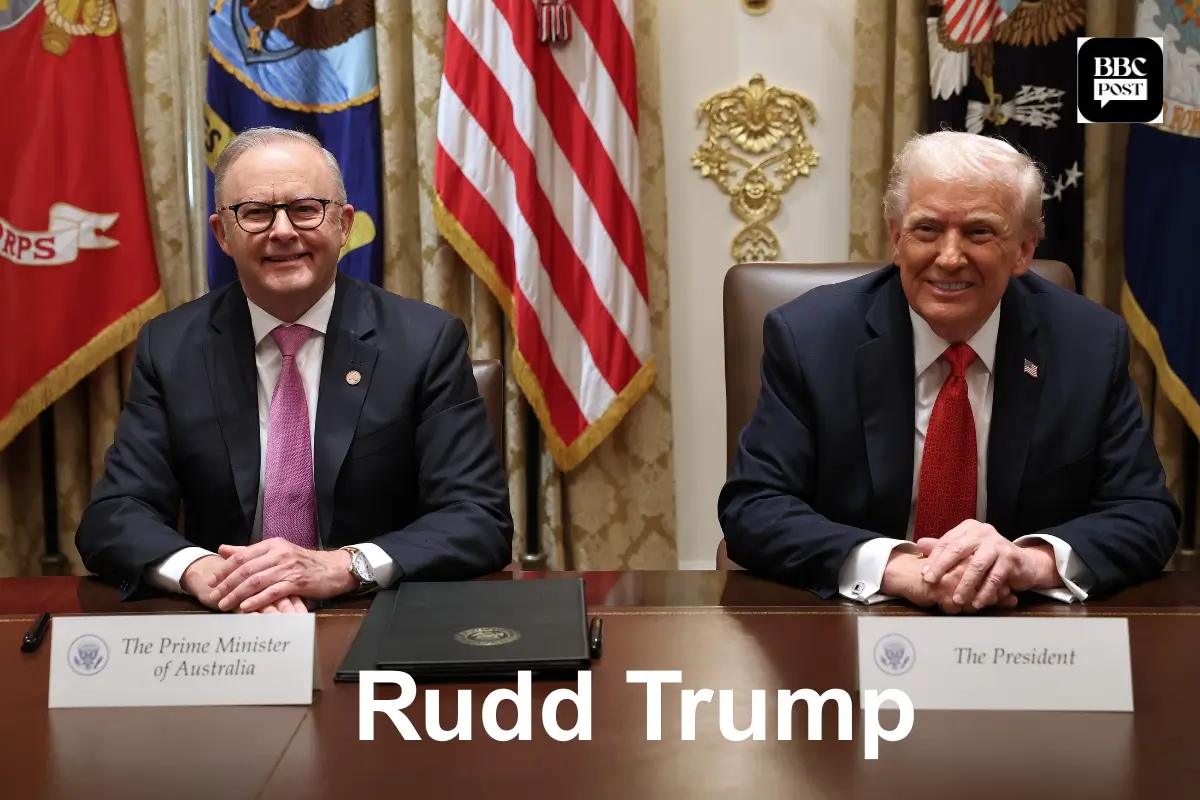
Following a series of events that included diplomacy, personal history, alliance politics, and national security decision-making, the term “rudd trump” has become one of the most searched political combinations in Australia and the US. A narrative about the intersection of political memory, leadership style, and strategic objectives at the highest level has grown out of what first seemed to be an unpleasant interaction during a White House meeting.
In actuality, the phrase “rudd trump” today describes two distinct but related trends. The first concerns Australia’s former prime minister and ambassador to the US, Kevin Rudd, and his heated public exchange with President Donald Trump at a meeting with Prime Minister Anthony Albanese. The second relates to Trump’s nomination of Joshua M. Rudd, a senior US Army commander, to head US Cyber Command and the National Security Agency (NSA), two of the most influential and delicate organisations in US national security.
The political climate surrounding Trump’s second term and the difficulties confronting Australia’s most significant partnership are clearly shown by these similar tales taken together.
Donald Trump and Kevin Rudd during the White House Meeting
As a member of the Australian delegation headed by Prime Minister Anthony Albanese, Kevin Rudd went to the White House meeting. After many phone conversations earlier in the year, it was Albanese and Trump’s first in-person encounter since Trump’s reelection. The goal of the summit was to strengthen U.S.-Australian collaboration in the areas of commerce, defence, and vital supply chains, especially in the Indo-Pacific region.
The official agenda was focused on defence cooperation, economic security, and alliance stability. However, the conversation took an unexpected turn during the meeting’s press section when an Australian journalist questioned Trump about if his opinion of the Albanese administration had changed as a result of Australia’s ambassador’s earlier remarks.
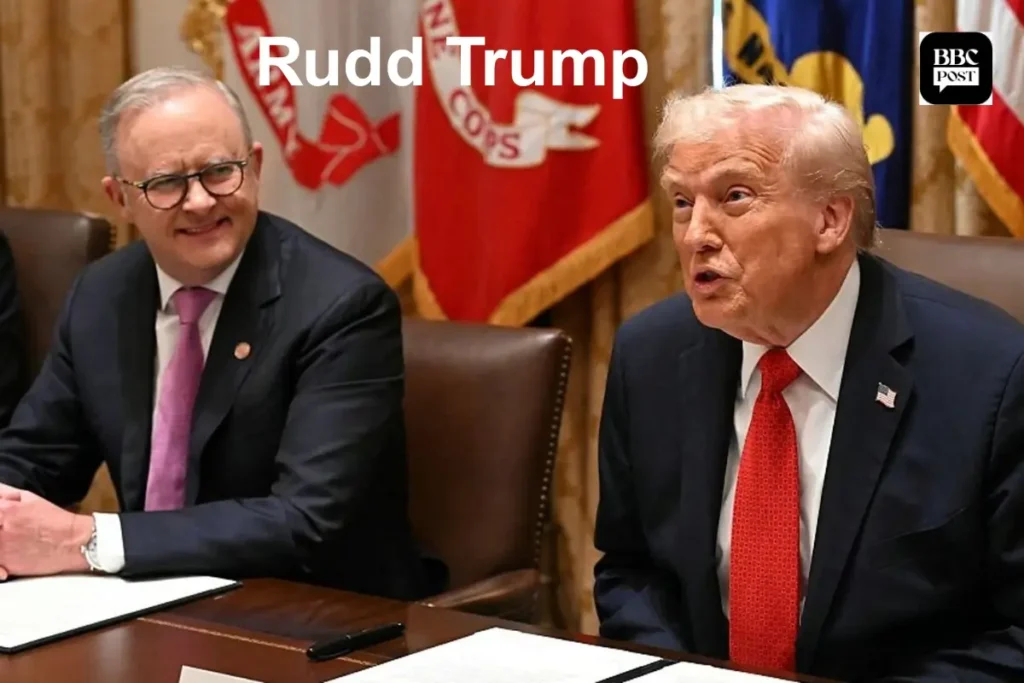
At first, Trump seemed confused about Kevin Rudd, inquiring as to whether he was still employed by Albanese and whether he had made any “bad” remarks about him. In a composed reply, Rudd clarified that any remarks were made prior to his appointment as ambassador and did not accurately represent his position as Australia’s official envoy in Washington.
Then, speaking directly to Rudd, Trump said, “I don’t like you either, and I probably never will.”
Some of the others at the table, including Albanese, laughed at the comment. The conversation swiftly became the meeting’s pivotal moment in media coverage throughout Australia, the US, and beyond, notwithstanding the response in the room.
The Context: Kevin Rudd’s Previous Remarks Regarding Trump
The remarks that Trump cited were made in 2020, while Kevin Rudd was out of government. Rudd had expressed concerns about Trump’s first-term leadership on social media at the time, posting a number of harshly worded attacks of the president.
One of the postings called Trump the “most destructive” president in American history. Long before Rudd was named Australia’s ambassador to the US, the comments were made in a private capacity.
Rudd removed the postings in November 2024 after Trump won the 2024 election, officially claiming that he did so out of respect for the administration and his diplomatic duties. Even if the postings were taken down, their substance was still extensively published and available via media archives, so it was almost a given that they would resurface during Trump’s second term.
The Australian Government’s Reaction to Rudd’s Apology
After the journalists left the room after the public confrontation at the White House, Kevin Rudd reportedly approached Trump in private and apologised for the prior statements, according to reports from a number of publications.
According to reports, Trump replied that Rudd was pardoned. Later, Australian officials emphasised that the conversation had not harmed the bilateral relationship and characterised Trump’s remarks as lighthearted.
Rudd was publicly supported by Prime Minister Albanese, who called him dedicated, productive, and diligent in Washington. Albanese underlined that, especially at a period of increasing international unrest, Rudd remained instrumental in fortifying Australia’s ties with the United States.
Trump’s Follow-Up Statements and Unresolved Conflict
Trump reportedly apologised, but his later remarks raised the possibility that the matter was not entirely settled. Days later, when asked whether the situation had been resolved, Trump said that he didn’t know much about Rudd and added, “When people say bad things about me, I don’t forget.”
The comments challenged the Australian government’s assertion that the issue was resolved and strengthened Trump’s reputation for recalling personal attacks even years after they occurred. They also highlighted the difficulty ambassadors have when interacting with a leader who combines personal grievances with public decision-making.
Australia’s Political Reaction
In Australia, the encounter immediately spurred political discussion. At first, opposition leader Sussan Ley called Rudd’s stance “untenable,” claiming that his prior remarks had damaged his reputation as an ambassador.
But as the week went on, that criticism became less harsh. Senior opposition leaders recognised Rudd’s background, his established connections in Washington, and the need of maintaining Australia’s diplomatic presence.
Albanese persisted in his adamant defence of Rudd, saying that he was working relentlessly and doing a “fantastic job” for Australia. The incident highlighted the challenges encountered by senior ambassadors whose prior public remarks may come up again in erratic political situations.
The Results of the Rudd-Trump Trade Discussions
The White House meeting produced significant policy accomplishments in spite of the interpersonal strain. A multibillion-dollar vital minerals deal, aimed at bolstering supply chains for rare earths and other important resources, was signed by Trump and Albanese.
Advanced manufacturing, electronics, renewable energy technology, and military systems all depend on these minerals. The deal represented a common goal of securing supply chains across allies and was seen as a reaction to China’s hegemony in rare earth processing.
There was no agreement on lowering tariffs, according to Australian authorities. To prevent misunderstandings over more extensive trade concessions, the meeting’s trade conclusions were restricted to the key minerals framework.
Trump’s Support for AUKUS
During the discussion, Trump also publicly reiterated his strong support for Australia, the United States, and the United Kingdom’s AUKUS nuclear-powered submarine alliance.
Given past rumours that the treaty would come under additional examination under his administration, his backing was widely scrutinised. Leaders in Australia applauded Trump’s remarks, claiming they cleared up any doubt on the US commitment to AUKUS.
However, analysts pointed out that Trump’s policy stances are subject to swift shifts and that sustained political backing in the US is necessary for long-term stability.
The opening for the US Ambassador to Australia
Trump was questioned during his follow-up comments on the open position of US ambassador to Australia, which hasn’t been filled since Caroline Kennedy left earlier this year.
Trump said that he intended to nominate someone Albanese would appreciate and that he had “someone in mind” for the position. He went on to say that a lot of individuals aspired to be ambassadors to Australia, highlighting the bilateral relationship’s symbolic significance.
Donald Trump and Joshua Rudd: A Different National Security Story
A distinct but noteworthy development involving Lieutenant General Joshua M. Rudd, a top US Army commander, occurs concurrently with the Kevin Rudd case.
After months of uncertainty at the head of America’s cyber and intelligence apparatus, Trump rushed to select Joshua Rudd to command both the US Cyber Command and the National Security Agency (NSA).
Currently, Joshua Rudd is the deputy commander of US Indo-Pacific Command (INDOPACOM), one of the US military’s most strategically significant regional commands.
The Confirmation Procedure in the Senate
The Senate Armed Services Committee received Joshua Rudd’s nomination, which was legally recorded in the Congressional Record. Thirty days later, the Senate Intelligence Committee was to review it.
The positions of NSA director and Cyber Command commander are not specifically mentioned in the nomination notification. The elevation to four-star general, which is necessary for the dual-hat leadership role supervising both agencies, is instead noted.
The Military Experience of Joshua Rudd
Joshua Rudd has decades of military service, including in top leadership positions and special operations. His professional background comprises:
- Acting as INDOPACOM’s chief of staff
- In charge of Special Operations Command Pacific
- Several deployments to Afghanistan and Iraq
- Senior commanders in US special forces units
Despite having a wealth of operational experience, Rudd has never held a top cyber or intelligence leadership position, which has garnered criticism from experts and MPs.
The Significance of the Leadership Gap Between the NSA and Cyber Command
After Trump abruptly fired previous director general Timothy Haugh, the NSA and Cyber Command have been without permanent leadership for almost eight months.
Following a meeting with far-right activist Laura Loomer, Haugh and his deputy were dismissed. This action sparked outrage from MPs and highlighted questions about political meddling in national security leadership.
Both institutions have been under the interim leadership of Lieutenant General William Hartman since April. Prior to the administration’s change of direction, Hartman was reportedly Trump’s favoured replacement. After a permanent successor is established, he is anticipated to retire.
Senate Apprehensions and Support for the Nomination
Mark Warner, vice chair of the Senate Intelligence Committee, said that the instability rendered the United States less secure and blasted the protracted delay in selecting a permanent chief. He said that leadership vacancies undermine national defences, citing persistent cyberthreats from China, Russia, Iran, and criminal actors.
Senator Mike Rounds, a member of the Intelligence and Armed Services committees, said that although having extensive knowledge of cyberspace is beneficial, it is not necessary. According to him, top commanders may depend on specialised teams to oversee technological operations and often cooperate with cyber capabilities.
Public Reaction and Media Coverage
Videos of Trump’s conversation with Kevin Rudd went viral on the internet, social media, and television. Trump’s personal manner, his recollection of previous criticism, and the ramifications for foreign ties were the main topics of public response.
While mainstream coverage focused on the meeting’s wider strategic results, online forums debated whether Rudd’s position had been undermined.
Solving the “Rudd Trump” Mysteries
Online misunderstanding has resulted from the prominence of the search phrase “rudd trump.” It’s critical to differentiate between:
- Kevin Rudd, the former prime minister and ambassador of Australia
- Joshua Rudd, a lieutenant general in the US Army, has been proposed to head Cyber Command and NSA.
- Paul Rudd is an unrelated actor.
- Unrelated tennis player Casper Ruud
Joshua Rudd and Kevin Rudd have very different political backgrounds and are unrelated.
What We Can Learn from the Rudd Trump Story
A personal approach to diplomacy, a keen recall for criticism, and decisive—sometimes abrupt—action on national security appointments are characteristics of Donald Trump’s leadership that are highlighted in the larger Rudd Trump narrative.
The incident highlights how difficult it is for Australia to manage its most significant alliance in a setting where personalities and policy interests coexist. Kevin Rudd continues to work on regional security, trade, and defence while serving as Australia’s ambassador in Washington. If Joshua Rudd’s nomination is accepted, it will influence US intelligence and cyber strategy at a time of increased international danger.
As the tale progresses, it provides a striking illustration of the ways in which power, memory, and diplomacy interact in modern politics.
Conclusion
The incidents between President Donald Trump and Ambassador Kevin Rudd bring to light the difficult balancing act that current foreign relations need between diplomacy and personal history. A small conversation at a White House meeting swiftly expanded into a larger conversation on leadership style, political memory, and the reality of defending the country’s interests in front of a highly scrutinised public.
The relationship between the United States and Australia is still based on common strategic goals, notwithstanding the public friction. Trump and Prime Minister Anthony Albanese’s meeting produced tangible results, including as a crucial minerals deal to fortify supply chains and renewed support for the AUKUS defence collaboration. These occurrences indicate that the alliance is still shaped by policy collaboration, even when personal comments might make headlines.
Trump’s leadership style, however, combines directness with a lengthy history of criticism, as shown in his handling of the Rudd exchange and his national security selections. The incident serves as a reminder to Australia of the need of cautious diplomacy in a setting where remarks made in the past may come back to haunt current relations.
The Rudd Trump narrative serves as a reminder that, as the situation develops, diplomacy now takes place at the nexus of personal ties, public record, and strategic imperative. In the next months, how these factors are handled will continue to be crucial to the stability and strength of the Australia-US partnership.
FAQs
Who is Ambassador Rudd?
Ambassador Rudd is Kevin Rudd, a former Australian prime minister who currently serves as Australia’s ambassador to the United States, representing Australia’s diplomatic and strategic interests in Washington.
What did the Australian ambassador say about Trump?
Before becoming ambassador, Kevin Rudd criticised Donald Trump on social media in 2020, including describing him as the “most destructive” US president. These comments were later deleted after Trump’s re-election.
Why did Trump criticise Ambassador Rudd publicly?
Trump responded to questions about Rudd’s past remarks during a White House meeting, telling him, “I don’t like you either, and I probably never will,” referencing those earlier criticisms.
Did Ambassador Rudd apologise to Trump?
Yes. Following the public exchange, Kevin Rudd reportedly apologised to Donald Trump privately after the press left the meeting room. Trump was reported to have said Rudd was forgiven.
What is the latest Trump news involving Australia?
Recent Trump news involving Australia includes his meeting with Prime Minister Anthony Albanese, support for the AUKUS defence pact, and the signing of a critical minerals agreement between the two countries.
What is Trump’s current approval rating?
Trump’s approval rating varies by poll and outlet. Recent US media reporting shows mixed public opinion, with support remaining strong among his base while broader national approval remains divided.
How has Trump responded to criticism in recent news?
In recent Trump news today, the president has said he does not forget when people “say bad” things about him, reinforcing his long-standing tendency to recall past criticism.
How has US media, including MSNBC, covered the Rudd-Trump exchange?
US outlets, including MSNBC, have highlighted the exchange as an example of Trump’s direct style and personal approach to diplomacy, while also noting that broader Australia–US policy cooperation continues.

