

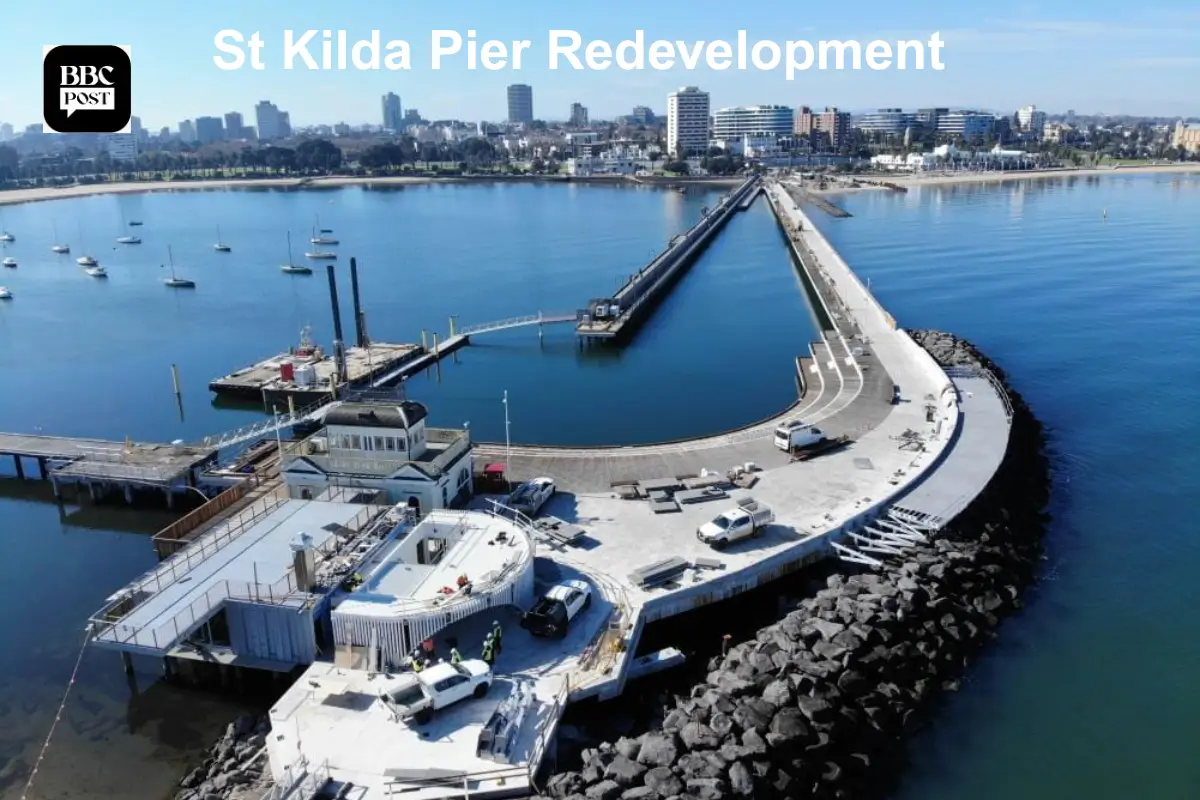
One of Melbourne’s most ambitious, meticulously recorded, and publicly involved waterfront infrastructure projects to date is the St Kilda Pier renovation. The project is more than just a structural reconstruction; it is a long-term investment in wildlife conservation, public access, historical preservation, and climate resilience along one of Victoria’s most iconic coastal areas.
The renovation, which was carried out by Parks Victoria with support from the Victorian Government, replaces the dilapidated pier with a contemporary, easily accessible, and future-ready building. After the public reopening in December 2024, construction was formally finished in November 2025. About 925,000 people have visited the rebuilt pier since it reopened, solidifying its place as one of Melbourne’s most popular tourist spots.
Overview of the project and its verified status
The reconstruction of St Kilda Pier in Bunurong/Boonwurrung Sea Country acknowledged the region’s cultural and historical value. After decades of exposure to seawater, wave action, and extensive public usage, the pier had reached the end of its useful life and needed to be completely replaced.
The Victorian Government invested $53 million to complete the project. In collaboration with the City of Port Phillip and the Department of Transport and Planning, Parks Victoria served as the customer and primary delivery agency. The new pier, which is around 450 metres long from beach to the breakwater, is mostly made of concrete and wood, materials chosen for their endurance and ability to provide visitors with comfort in a maritime setting.
St Kilda Pier is currently fully operational, and the project status is recorded as Completed (2025).
Why it was necessary to renovate St Kilda Pier
The previous St Kilda Pier had become more challenging and expensive to maintain before it was renovated. The tiny deck and antiquated design no longer complied with contemporary accessibility regulations, while structural deterioration from decades of exposure to the shore prompted safety issues.
Parks Victoria determined that the pier needed a complete replacement rather than pursuing temporary fixes. This presented a chance to redesign the pier’s use as a public area in addition to rebuilding the structure. Enhancing pedestrian and vehicular safety, increasing public space, safeguarding the Little Penguin colony, and making sure the pier could adapt to changing weather conditions were the goals of the renovation.
The new curving pier and the design concept
The new structure’s curving orientation is one of the St Kilda Pier redevelopment’s distinguishing characteristics. This was created after much deliberation, engineering research, and wave modelling, and it replaces the previous straight-out pier.
By guaranteeing safer access for cars and pedestrians, enhancing wind protection, and producing a more protected atmosphere, the curved shape improves the visiting experience. Additionally, it offers better views of Melbourne’s skyline and across Port Phillip Bay, enticing tourists to pause, slow down, and take in the coastal scenery.
Enhancements to public spaces and accessibility
The reconstruction was based on the fundamental idea of accessibility. Wheelchair users, those with mobility aids, families with strollers, and elderly visitors will find the new pier simpler and safer thanks to its larger, completely disability-compliant path.
Additionally, the wider area facilitates access for maintenance and emergency vehicles. The broader deck eases traffic and boosts safety during busy times, such weekends and summer nights.
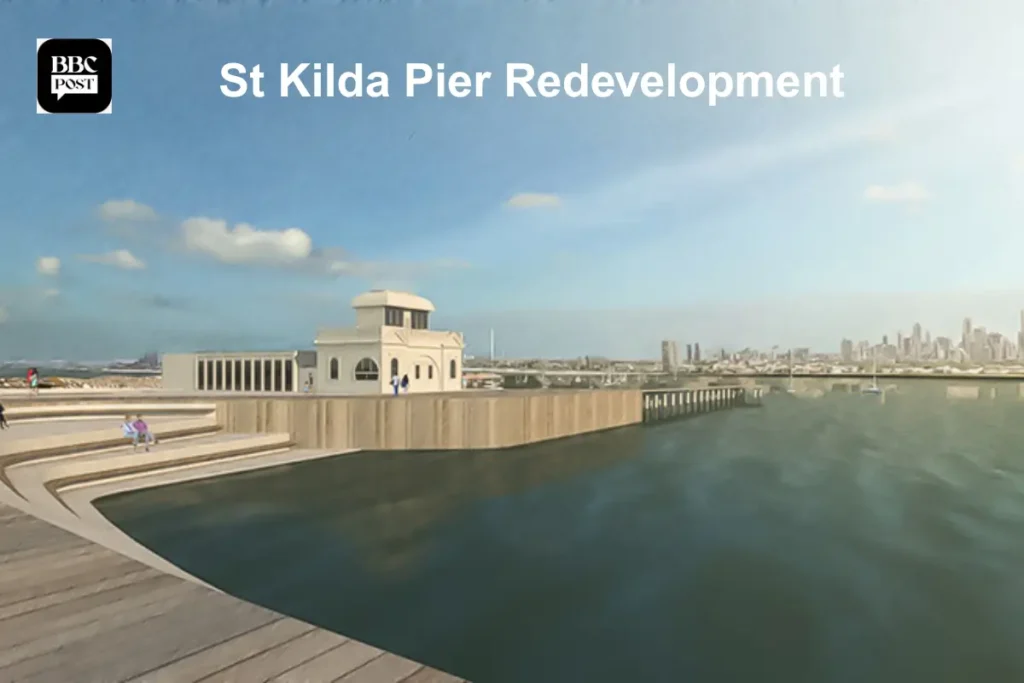
Tiered sitting and meeting spaces are also part of the project, especially close to the St Kilda Pier Kiosk and important viewing locations. By creating places to relax, socialise, and take in the scenery, these spaces turn the pier from a means of getting to the breakwater into a destination.
Public facilities and the comfort of guests
Given the number of visitors to St Kilda Pier, the reconstruction includes new public restrooms, solving a long-standing problem.
Materials were chosen with endurance and function in mind. Concrete delivers strength, durability, and a tactile surface that reacts to the coastal environment; mesh flooring at observation platforms lets visitors feel the flow of waves under their feet; and timber offers warmth and comfort for sitting and relaxing.
Keeping the St Kilda Pier Kiosk in place
One of the pier’s most important and beloved features is still the St Kilda Pier Kiosk. The design team worked closely with partners to identify and protect important aspects that convey the narrative of St Kilda Pier, and heritage played a crucial role in the renovation.
Aspects of the new design were influenced by the architecture of the kiosk, which is included in the Victorian Heritage Inventory. In order to maintain continuity between old and modern features, the new buildings’ subtle curves make reference to the kiosk shape.
Preserving the colony of Little Penguins
Since the 1956 Melbourne Olympics, a colony of Little Penguins has lived along the St Kilda breakwater. Unmanaged access started to put strain on penguin care and breeding grounds as visitor numbers increased over time.
One of the main goals of the reconstruction was to safeguard the colony while permitting public sight.
The boardwalk and tourist experience for observing penguins
A specially constructed over-water penguin viewing walkway is part of the renovation, which aims to enhance viewing while preserving delicate breeding habitat. The walkway protects people safe from nesting places and keeps tourists away from the breakwater.
Phillip Island Nature Parks runs the penguin watching programme, which is a free ticketed event that requires reservations. There are two guided viewing sessions every night on the promenade. A minimum of 150 guests may be accommodated every session, with a maximum of 300 guests per night.
This controlled method lessens congestion, enhances penguin care, and guarantees tourists a fun and safe experience.
Materials, engineering, and construction
Marine engineering is a major component of the new St Kilda Pier. Reflecting the project’s size, the construction process included tens of thousands of bolts, hundreds of steel piles, hundreds of concrete segments, and thousands of wood deck boards.
Durability, public pleasure, and environmental protection are given first priority along the almost 600 metres of skilfully constructed infrastructure. Tour operators and ferry passengers may more easily reach a low landing close to the coast, which enhances maritime services’ operation.
Future-proofing and climate resilience
The rebuilding incorporates climate change adaptation. As guests go throughout its length, the pier gradually climbs in height, improving its ability to adapt to future sea level rise.
During storms, tourists are shielded from wave overtopping by a wave wall that was created using intricate wave and climate simulations. When taken as a whole, these steps are meant to ensure that the pier remains secure and functional for at least the next fifty years.
Archaeology and the preservation of heritage
Heritage concerns went below the waterline since the location was on the Victorian Heritage Inventory. A Maritime Archaeological Management Plan and Maritime Impact Assessment were completed as part of the renovation, and artefacts on the seabed are safeguarded.
In order to convey the site’s maritime history, cultural value, and rehabilitation journey, new interpretive signage has been erected on the pier and the shoreline.
Credits, consultants, and the design team
Jackson Clements Burrows (JCB) served as the principal consultant for the renovation, collaborating with AW Maritime Engineers and Site Office Landscape Architects.
North Projects, WSP, Electrolight, Bryce Raworth, EnviroMe, Ecology & Heritage Partners, CEE Environmental, Du Chateau Chun, Traffix Group, Ark Resources, Geotesta, and Gertzel were among the consultants.
Peter Clarke took project photos, using JCB_St_Kilda_Pier_1002LR and JCB_St_Kilda_Pier_4261LR as internal references.
Public updates and community involvement
Over many years, the project was developed by community interaction. In 2017, the first round of engagement started by asking the community how they utilised the pier and what they would like to see improved. According to feedback, the entryway could have done a better job of celebrating the area’s history, nature, and penguins since it seemed unimpressive.
The second round of the engagement focused on the draft concept design and produced alterations such as new seats, drinking fountains, trash cans, and pedestrian pathways close to the Sea Baths.
Parks Victoria released the following updates for the community:
Community Newsletters:
1 for May 2020;
2 for August 2020;
3 for December 2020;
4 for April 2021;
5 for November 2021;
6 for May 2022;
7 for September 2022;
8 for December 2022
Community Newsletters
9–March 2023,
10–September 2023, and
11–December 2023 in succession
Community Newsletters
12 through May 2024,
13 through September 2024,
14 through December 2024, and
15 through November 2025
Additionally, a Penguin Management Fact Sheet (2022) was published.
Key phases were captured on project films, such as the thorough design tour in May 2021, the project’s development in September 2023, the new low landing, penguin management, and seasonal updates in 2024 and 2025.
Through the Have Your Say project site, visitors may express their interest and sign up for updates.
An explanation of the St Kilda Pier Foreshore Upgrade
The St Kilda Pier Foreshore Upgrade, which is being carried out by the City of Port Phillip, is distinct from the St Kilda Pier redevelopment. This project enhances the public space nearby and brings the pier’s architecture onto land.
Milestones, scope, and effects of the foreshore improvement
A new concrete plaza, sitting nooks next to Catani Gardens, enhanced lighting and navigation along the Bay Trail, tour bus drop-off zones, palm tree planting, better stormwater drainage, and an expansion of the pier access to Jacka Boulevard are all part of the foreshore project.
Reviewing input on March 31, 2024, releasing the final concept plan on April 30, 2024, finishing the detailed design on July 31, 2024, starting construction on August 29, 2025, and anticipating completion on February 12, 2026 are some of the milestones.
There will be temporary parking lot modifications, traffic restrictions, protective fencing, and pedestrian diversions during construction. The Royal Melbourne Yacht Squadron and the Sea Baths are involved in the coordination of the work.
Investment recovery is anticipated within five years, and funding is supplied by the City of Port Phillip, the Victorian Government, and the Australian Government via the Thriving Suburbs Programme.
The implications of the redevelopment for Melbourne
A safer, more accessible, and more resilient public area is the result of the finished St Kilda Pier renovation. Improved facilities, seats, views of the harbour and skyline, and a supervised penguin watching experience that puts animal care first are all advantages for visitors.
The project enhances St Kilda’s standing as one of Melbourne’s most significant seaside attractions when combined with the foreshore improvement.
Conclusion
The renovation of St Kilda Pier represents a turning point in the development of one of Melbourne’s most famous waterfront attractions. Once an outdated building nearing the end of its useful life, it has been renovated into a contemporary, durable, and accessible public area that honours its past while satisfying the demands of modern tourists.
The redevelopment has produced safer access, better public amenities, better views of Port Phillip Bay and Melbourne’s skyline, and a well-managed penguin viewing experience that safeguards one of the city’s most distinctive urban wildlife colonies thanks to careful design, strong community engagement, and long-term planning. The historical kiosk and the addition of interpretative signs guarantee that the pier’s maritime and cultural past will always be appreciated and visible.
Now that work is finished and the foreshore renovation is extending these improvements onto land, St Kilda Pier is once again a popular destination for tourists and a hub for residents to congregate. The renovated pier guarantees its status as a long-lasting asset for Melbourne’s coastline, guaranteeing that future generations may enjoy it. It is built to endure future climatic problems and accommodate large tourist numbers.
FAQs
Is the new St Kilda Pier finished?
Yes. The St Kilda Pier redevelopment is officially complete. Construction works were finalised in November 2025, and the pier has been open to the public since December 2024.
How much did it cost to renovate the St Kilda Pier?
The redevelopment was delivered with a $53 million investment from the Victorian Government. This funding covered the full rebuild of the pier, new public amenities, accessibility upgrades and the penguin viewing infrastructure.
Who built the new St Kilda Pier?
The project was delivered by Parks Victoria in partnership with the Department of Transport and Planning and the City of Port Phillip. The design was led by Jackson Clements Burrows, with Site Office Landscape Architects and AW Maritime Engineers, supported by a large team of specialist consultants.
How do I get to the new St Kilda Pier?
St Kilda Pier is located on the St Kilda foreshore in Melbourne. It can be reached by tram services along The Esplanade and Fitzroy Street, by bus, or by car with nearby parking around Jacka Boulevard and the St Kilda Sea Baths. Walking and cycling access is also popular via the Bay Trail.
Which suburb is booming in Melbourne?
Several Melbourne suburbs are experiencing strong growth, particularly inner and bayside areas with major infrastructure and lifestyle upgrades. St Kilda continues to attract attention due to the pier redevelopment, foreshore upgrades and its proximity to the CBD, beaches and entertainment precincts.
How long will the North East Link take to build?
The North East Link is a separate Victorian infrastructure project and is not related to the St Kilda Pier redevelopment. Construction is expected to take several years from commencement to completion, with staging and timelines set by the Victorian Government.
What are the four no-go suburbs in Melbourne?
There is no official list of “no-go suburbs” in Melbourne. Perceptions about suburbs can vary over time and are influenced by factors such as housing affordability, infrastructure, local services and personal preference. Most Melbourne suburbs continue to evolve and change.
What’s the purpose of a new pier?
The purpose of a new pier is to provide safe and accessible public access to the water, support tourism and recreation, protect marine and wildlife environments, and ensure long-term resilience against coastal and climate impacts. The St Kilda Pier redevelopment was designed to achieve all of these outcomes while preserving heritage and improving the visitor experience.

