

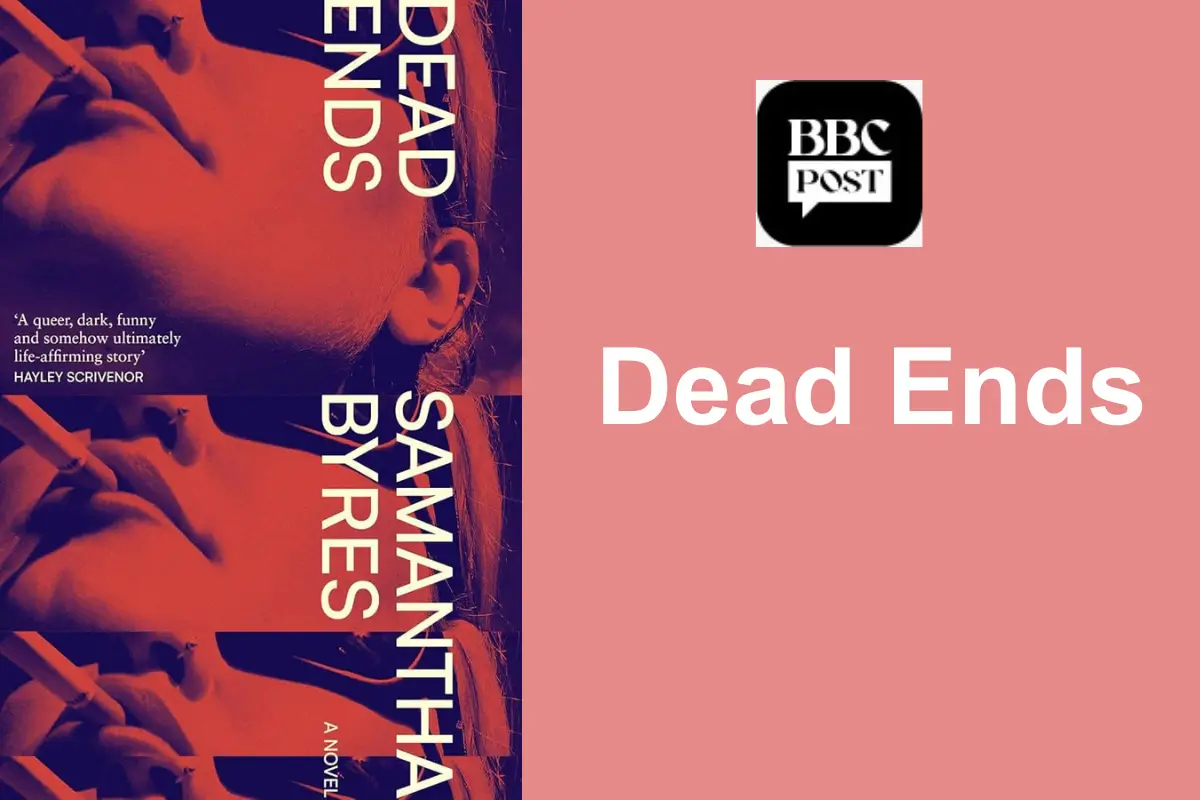
Dead Ends by Samantha Byres is a darkly comic mystery that explores grief, memory, prejudice and the dangerous comfort of familiar mistakes. Published by the University of Queensland Press in July 2025, the novel announces itself as a confident and emotionally intelligent debut, one that blends noir elements with sharp humour and psychological depth. Rather than offering neat answers or comforting resolutions, Dead Ends is concerned with what lingers: unresolved loss, unspoken guilt and the human urge to fix the past even when doing so only deepens the damage.
Set largely in a small hometown in Aotearoa New Zealand, the novel examines the emotional consequences of returning to a place you once escaped. It is a story about obligation rather than choice, about desire shaped by grief, and about how belief can become both a refuge and a trap.
Nell Jenkins and the Myth of Reinvention
At the centre of Dead Ends is Nell Jenkins, described early on as an “all-round chaos merchant”. Nell is not presented as a character on a journey towards redemption. She is impulsive, emotionally volatile and sharply aware of her own self-sabotaging tendencies, yet repeatedly drawn back to them. This tension between insight and action drives the novel and gives it much of its emotional force.
Nell returns to her hometown after years away, summoned back not by success or nostalgia, but by responsibility. Her mother has suffered a stroke, and her brother has already carried the burden of caring for their father through cancer. With her brother exhausted and family obligations unavoidable, Nell’s return feels less like a homecoming and more like a reckoning.
Her escape from home as a teenager was an act of survival, not rebellion. Coming back exposes how little emotional distance she has truly gained. The idea that time away equals growth is quietly dismantled as Nell steps back into the life she thought she had left behind.
Sydney, Failure and Unfinished Business
Nell’s years in Sydney are not framed as a period of transformation. Instead, they are defined by instability and unresolved conflict. She arrives home with nothing tangible to show for her time there beyond a string of failed relationships, poorly paid jobs and an ongoing HR complaint against her ex-girlfriend, who was also her boss.
This unresolved complaint is more than a background detail. It reflects one of the novel’s central concerns: the collapse of boundaries between intimacy and power, and the personal consequences of blurred professional relationships. Sydney, often imagined in Australian and New Zealand fiction as a place of opportunity and reinvention, offers Nell no clean break. Her problems follow her home, unresolved and heavy.
Returning to a Small Town That Never Forgets
The small town Nell returns to is portrayed without nostalgia. Samantha Byres captures the claustrophobia of close communities where everyone remembers who you were before you had the chance to change. Old friendships, long memories and entrenched roles make reinvention difficult, if not impossible.
Nell quickly slips back into old habits, not because she wants to, but because familiarity offers a strange sense of comfort. The novel shows how returning home can intensify guilt rather than resolve it, especially when grief and family history remain unspoken.
Family relationships are marked by obligation rather than warmth. Nell’s interactions with her mother and brother are shaped by silence, resentment and expectation. Care is given because it must be, not because it heals. Byres avoids sentimental portrayals of family, instead presenting it as a space where love and damage coexist uneasily.
Jacqui and the Weight of Community Ties
An important figure in Nell’s return is Jacqui, her mother’s best friend and the aunt of April, Nell’s childhood best friend who died years earlier. Jacqui is one of the people who summons Nell home, reinforcing how tightly personal history, community and obligation are bound together.
Jacqui also connects several emotional threads in the novel. She worked alongside Nell’s mother at a respite centre, the same place where Nell’s mother later stays following her stroke. This detail adds a layer of emotional irony, underscoring the sense that the past is never truly past in a small community. Work, family and care blur into one another, deepening Nell’s discomfort and guilt.
April and the Shape of Lingering Grief
April is not merely a piece of backstory. Although she died years earlier, her presence shapes the novel’s emotional architecture. April was Nell’s childhood best friend, and her death remains an open wound that continues to influence Nell’s decisions.
As teenagers, Nell and April shared an obsession with Petronella Bush, a television psychic who promised certainty and meaning. This shared fixation becomes significant later in the novel, linking grief, belief and nostalgia. April’s absence is felt not as something resolved, but as something that still demands attention.
The novel treats grief not as a process with stages, but as a force that intrudes repeatedly and unpredictably. Nell’s guilt is shaped by the belief that tragedy should have been foreseen, that warning signs were missed. This belief fuels her self-destructive behaviour and her tendency to punish herself long after logic suggests responsibility has ended.
Desire, Guilt and Emotional Risk
Emotionally adrift and under financial pressure, Nell enters into relationships that reflect her inner instability. One of these is with Mick, April’s older brother. Their relationship is shaped by shared loss and complicated by guilt. It offers closeness without clarity, comfort without resolution, and blurs emotional boundaries that were already fragile.
At the same time, Nell becomes involved with Katya, a newly arrived and equally unreliable figure who works as an assistant to Petronella Bush. Katya represents attraction without safety, desire without accountability. Nell’s pull towards her is driven by lust, loneliness and the need to escape the weight of responsibility pressing in from all sides.
These relationships are not portrayed as romantic solutions. They deepen Nell’s emotional confusion and draw her further into chaos, reinforcing the novel’s interest in how people choose intensity over stability when they are overwhelmed.
Petronella Bush and the Seduction of Certainty
Petronella Bush, a once-famous television psychic, is one of the novel’s most symbolically charged figures. As teenagers, Nell and April were captivated by Petronella’s on-screen persona and the certainty she appeared to offer. Her arrival in town years later collapses past and present, bringing unresolved obsessions back into focus.
Petronella embodies the human desire for meaning, especially in the aftermath of loss. Her charisma attracts people who are emotionally vulnerable, offering answers where none may exist. The novel does not reduce her to a simple villain. Instead, it examines the ethics of belief and the fine line between comfort and exploitation.
In a moment shaped by guilt, emotional exhaustion and cheap wine, Nell reveals deeply personal family information to Petronella, including details about her mother’s sister, who has been missing for decades. This disclosure becomes a turning point, drawing Nell deeper into Petronella’s orbit and opening up questions about truth, trust and responsibility that ripple through the narrative.
Prejudice, Community and Consequence
Dead Ends is also a novel about prejudice and its consequences. The small-town setting amplifies judgement, silence and long-held assumptions. Tragedies that people believe should have been prevented are often followed by blame, whether spoken or implied.
Byres explores how communities respond to loss, particularly when grief intersects with difference and discomfort. The novel shows how prejudice can shape memory, relationships and responsibility, often in ways that are subtle rather than overt.
Black Comedy and Narrative Tone
Despite its heavy themes, Dead Ends is frequently funny. The humour is dry, sharp and often uncomfortable, emerging from human frailty and bad decisions rather than cleverness for its own sake. Samantha Byres uses black comedy as a way of exposing emotional truth rather than softening it.
This balance between humour and pain keeps the novel propulsive, allowing readers to engage with difficult material without emotional fatigue.
Genre, Queer Representation and Literary Context
Dead Ends draws on noir traditions without committing to their conventions. There are mysteries and moral ambiguity, but no promise of tidy resolution. The novel prioritises emotional consequence over plot closure, aligning it with contemporary Australian and New Zealand fiction that values psychological depth.
Queer relationships are central to the story but are not idealised. Power imbalances, emotional dependency and blurred professional boundaries are explored without simplification, contributing to the novel’s realism and relevance.
Critical Response and Publication Details
The novel has been favourably compared to works such as Deadloch, Top of the Lake and Too Much Lip. Reviewers have praised its compulsive readability, flawed yet compelling protagonist and emotional honesty, describing it as tense, darkly funny and painfully real.
Dead Ends was published by the University of Queensland Press and released in paperback on 1 July 2025. The novel spans 304 pages and is priced at A$34.99.
Conclusion
Dead Ends is a novel about the danger of trying to fix the past and the comfort people find in repeating familiar mistakes. Through Nell Jenkins, Samantha Byres explores how grief distorts desire, how belief can become a trap, and how returning home can force unresolved pain into the open.
Dark, funny and emotionally unflinching, the novel refuses easy answers. It lingers because it leaves wounds exposed rather than neatly closed, marking Samantha Byres as a significant new voice in contemporary fiction.
FAQs
What is Dead Ends by Samantha Byres about?
Dead Ends follows Nell Jenkins, a woman who returns to her small hometown after years away to care for her family. The novel explores grief, desire and the consequences of unresolved loss, blending dark humour with mystery.
Who is the main character in Dead Ends?
The main character is Nell Jenkins, described as an “all-round chaos merchant”. She is impulsive, self-aware and emotionally conflicted, shaped by grief, family obligation and a pattern of risky decisions.
Where is Dead Ends set?
The story is largely set in a small hometown in Aotearoa New Zealand, with parts of Nell’s past linked to her time living in Sydney.
Is Dead Ends a crime or mystery novel?
While Dead Ends contains mystery elements, it is primarily a character-driven novel. It draws on noir influences but focuses more on emotional consequences than on solving a single crime.
Who is Petronella Bush in the novel?
Petronella Bush is a once-famous television psychic whose arrival in town draws Nell into her orbit. She represents belief, certainty and the human desire for answers in the face of grief.
What themes does Dead Ends explore?
The novel explores grief, unresolved loss, prejudice, desire, family obligation and the danger of trying to fix the past. It also examines how small communities respond to tragedy.
Is Dead Ends a queer novel?
Yes. Queer relationships are central to the story, presented realistically and without idealisation, including power imbalances and emotional complexity.
When was Dead Ends published and who is the publisher?
Dead Ends was published on 1 July 2025 by the University of Queensland Press in paperback format.

